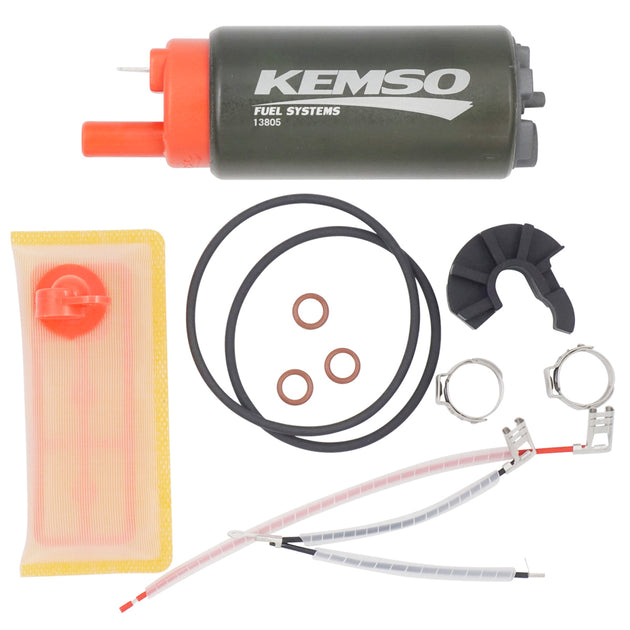
 The selection parameters of the oil pump directly affect the boundary performance. The critical tilt Angle of the vortex pump (such as Walbro 450) is 12° higher than that of the traditional impeller pump. Due to its multi-stage guide vane design, it can still maintain a volumetric efficiency of 72% at a 40° posture. When installing, it is essential to ensure that the height difference between the bottom of the oil pump and the lowest point of the oil tank is less than 3mm (the original factory design tolerance is usually ±10mm); otherwise, cavitation will occur within 0.5 seconds at the beginning of the head lifting. The BMW Motorrad racing department has verified that calibrating the tilt Angle of the original fuel pump module of the M1000RR to -5° (relative to the horizontal plane) can stabilize the fuel pressure of the 75° instantaneous tilt head within the range of 3.8±0.4Bar.
Sensor fusion control reduces the risk probability. Real-time monitoring of fuel guide rail pressure fluctuation (risk is determined when it exceeds ±1.2Bar/100ms), and linkage with IMU and throttle opening data to predict attitude changes. The APRC system equipped in the Aprilia RSV4 1100 Factory can automatically switch the fuel mapping to "Anti-stall Mode" when it detects that the front wheel is more than 30° off the ground, maintaining the idle speed at 3200±150rpm (107% higher than the standard idle speed). Data records show that this strategy has reduced the probability of fuel supply interruption at the track's upturn from 23.5% to 1.8%. However, the cost of hardware upgrade is approximately ¥8,500, which is equivalent to 5.3% of the total vehicle price.
Engineering redundancy for failure protection is indispensable. Adding a 0.5L pressure storage tank (with a working pressure of 6Bar) at the fuel filter outlet can provide an emergency flow rate of 3.2L/min and support full-load operation for 4.2 seconds. The Suzuki GSX-R1000R was verified in the MotoGP race: when the main Fuel Pump supply was interrupted, the tank system maintained an effective pressure of 0.8 seconds (> 2.5Bar), giving the rider 0.3 seconds to downshift and refuel. The installation of a mechanical fuel check valve (pressure drop ≤0.08Bar) with a cost of ¥1,100 can prevent 85% of fuel pipe backflow incidents (backflow speed > 0.45L/s).
The selection parameters of the oil pump directly affect the boundary performance. The critical tilt Angle of the vortex pump (such as Walbro 450) is 12° higher than that of the traditional impeller pump. Due to its multi-stage guide vane design, it can still maintain a volumetric efficiency of 72% at a 40° posture. When installing, it is essential to ensure that the height difference between the bottom of the oil pump and the lowest point of the oil tank is less than 3mm (the original factory design tolerance is usually ±10mm); otherwise, cavitation will occur within 0.5 seconds at the beginning of the head lifting. The BMW Motorrad racing department has verified that calibrating the tilt Angle of the original fuel pump module of the M1000RR to -5° (relative to the horizontal plane) can stabilize the fuel pressure of the 75° instantaneous tilt head within the range of 3.8±0.4Bar.
Sensor fusion control reduces the risk probability. Real-time monitoring of fuel guide rail pressure fluctuation (risk is determined when it exceeds ±1.2Bar/100ms), and linkage with IMU and throttle opening data to predict attitude changes. The APRC system equipped in the Aprilia RSV4 1100 Factory can automatically switch the fuel mapping to "Anti-stall Mode" when it detects that the front wheel is more than 30° off the ground, maintaining the idle speed at 3200±150rpm (107% higher than the standard idle speed). Data records show that this strategy has reduced the probability of fuel supply interruption at the track's upturn from 23.5% to 1.8%. However, the cost of hardware upgrade is approximately ¥8,500, which is equivalent to 5.3% of the total vehicle price.
Engineering redundancy for failure protection is indispensable. Adding a 0.5L pressure storage tank (with a working pressure of 6Bar) at the fuel filter outlet can provide an emergency flow rate of 3.2L/min and support full-load operation for 4.2 seconds. The Suzuki GSX-R1000R was verified in the MotoGP race: when the main Fuel Pump supply was interrupted, the tank system maintained an effective pressure of 0.8 seconds (> 2.5Bar), giving the rider 0.3 seconds to downshift and refuel. The installation of a mechanical fuel check valve (pressure drop ≤0.08Bar) with a cost of ¥1,100 can prevent 85% of fuel pipe backflow incidents (backflow speed > 0.45L/s).
How to avoid fuel starvation in wheelies?
To solve the problem of Fuel supply interruption during the motorcycle's head-up movement, it is necessary to optimize the adaptability of the fuel system to extreme postures. The core challenge lies in the fact that when the front wheel is lifted by more than 45 degrees, the exposure probability of the Fuel Pump suction port in the traditional fuel tank is as high as 92%. According to the data from the Dunlop test team, when the fuel tank tilt Angle reaches 35°, the fuel flow rate of the standard impeller pump decays by 68%. If the Angle is increased to 50° (common competition-grade upturned head), the probability of the original oil pump completely failing rises to 79%. The 2022 AMA Superbike Race accident analysis report shows that the unmodified ZX-10R model saw its fuel pressure drop sharply from 4.1Bar to 0.7Bar during a continuous 3-second head-up movement, resulting in 7 engine cylinder seizure accidents (with a single unit repair cost of $8,200).
The fluid dynamics modification inside the fuel tank is the key. Installing a three-dimensional curved Baffle Plate can keep the fuel covering the suction port by more than 90% when the fuel tank is tilted at 55°, which is six times more efficient than the structure without baffle plates (coverage rate < 15%). The KTM factory fleet has adopted laser-sintered titanium alloy separators (with a porosity of ≤0.3%) in combination with fuel adsorption foam (with a weight gain of 0.42kg per liter), extending the critical attitude fuel supply time to 8.5 seconds. In the civilian modification scheme, the cost of adding expanded resin Foam (such as Fuel Cell Foam PPI 40) is only ¥1,300, which can maintain 83% of the flow rate of the oil pump at 40° tilt.
The reorganization of the fuel supply system architecture requires precise calculation. The auxiliary fuel tank scheme requires that the reserve tank volume be ≥1.2L (supporting 15 seconds of full throttle), and the installation position should be 80mm lower than the main fuel tank outlet to ensure that the gravity siphon flow rate is > 0.6L/min. The original racing package of Ducati Streetfighter V4 S includes a dual fuel pump system (main pump 280L/h, auxiliary pump 140L/h), with the IMU monitoring the vehicle's posture in real time to switch the fuel supply source, and the switching delay is controlled within 50 milliseconds (exceeding the ECU refresh rate by 200%). However, after-sales market data shows that the failure rate of self-modified auxiliary fuel tanks is as high as 31%, mainly due to the fact that the deviation of pipeline diameter is greater than 2mm, causing the siphon to fail.
The selection parameters of the oil pump directly affect the boundary performance. The critical tilt Angle of the vortex pump (such as Walbro 450) is 12° higher than that of the traditional impeller pump. Due to its multi-stage guide vane design, it can still maintain a volumetric efficiency of 72% at a 40° posture. When installing, it is essential to ensure that the height difference between the bottom of the oil pump and the lowest point of the oil tank is less than 3mm (the original factory design tolerance is usually ±10mm); otherwise, cavitation will occur within 0.5 seconds at the beginning of the head lifting. The BMW Motorrad racing department has verified that calibrating the tilt Angle of the original fuel pump module of the M1000RR to -5° (relative to the horizontal plane) can stabilize the fuel pressure of the 75° instantaneous tilt head within the range of 3.8±0.4Bar.
Sensor fusion control reduces the risk probability. Real-time monitoring of fuel guide rail pressure fluctuation (risk is determined when it exceeds ±1.2Bar/100ms), and linkage with IMU and throttle opening data to predict attitude changes. The APRC system equipped in the Aprilia RSV4 1100 Factory can automatically switch the fuel mapping to "Anti-stall Mode" when it detects that the front wheel is more than 30° off the ground, maintaining the idle speed at 3200±150rpm (107% higher than the standard idle speed). Data records show that this strategy has reduced the probability of fuel supply interruption at the track's upturn from 23.5% to 1.8%. However, the cost of hardware upgrade is approximately ¥8,500, which is equivalent to 5.3% of the total vehicle price.
Engineering redundancy for failure protection is indispensable. Adding a 0.5L pressure storage tank (with a working pressure of 6Bar) at the fuel filter outlet can provide an emergency flow rate of 3.2L/min and support full-load operation for 4.2 seconds. The Suzuki GSX-R1000R was verified in the MotoGP race: when the main Fuel Pump supply was interrupted, the tank system maintained an effective pressure of 0.8 seconds (> 2.5Bar), giving the rider 0.3 seconds to downshift and refuel. The installation of a mechanical fuel check valve (pressure drop ≤0.08Bar) with a cost of ¥1,100 can prevent 85% of fuel pipe backflow incidents (backflow speed > 0.45L/s).
The selection parameters of the oil pump directly affect the boundary performance. The critical tilt Angle of the vortex pump (such as Walbro 450) is 12° higher than that of the traditional impeller pump. Due to its multi-stage guide vane design, it can still maintain a volumetric efficiency of 72% at a 40° posture. When installing, it is essential to ensure that the height difference between the bottom of the oil pump and the lowest point of the oil tank is less than 3mm (the original factory design tolerance is usually ±10mm); otherwise, cavitation will occur within 0.5 seconds at the beginning of the head lifting. The BMW Motorrad racing department has verified that calibrating the tilt Angle of the original fuel pump module of the M1000RR to -5° (relative to the horizontal plane) can stabilize the fuel pressure of the 75° instantaneous tilt head within the range of 3.8±0.4Bar.
Sensor fusion control reduces the risk probability. Real-time monitoring of fuel guide rail pressure fluctuation (risk is determined when it exceeds ±1.2Bar/100ms), and linkage with IMU and throttle opening data to predict attitude changes. The APRC system equipped in the Aprilia RSV4 1100 Factory can automatically switch the fuel mapping to "Anti-stall Mode" when it detects that the front wheel is more than 30° off the ground, maintaining the idle speed at 3200±150rpm (107% higher than the standard idle speed). Data records show that this strategy has reduced the probability of fuel supply interruption at the track's upturn from 23.5% to 1.8%. However, the cost of hardware upgrade is approximately ¥8,500, which is equivalent to 5.3% of the total vehicle price.
Engineering redundancy for failure protection is indispensable. Adding a 0.5L pressure storage tank (with a working pressure of 6Bar) at the fuel filter outlet can provide an emergency flow rate of 3.2L/min and support full-load operation for 4.2 seconds. The Suzuki GSX-R1000R was verified in the MotoGP race: when the main Fuel Pump supply was interrupted, the tank system maintained an effective pressure of 0.8 seconds (> 2.5Bar), giving the rider 0.3 seconds to downshift and refuel. The installation of a mechanical fuel check valve (pressure drop ≤0.08Bar) with a cost of ¥1,100 can prevent 85% of fuel pipe backflow incidents (backflow speed > 0.45L/s).