Energy Storage Cable Sitting Next to a PV Array
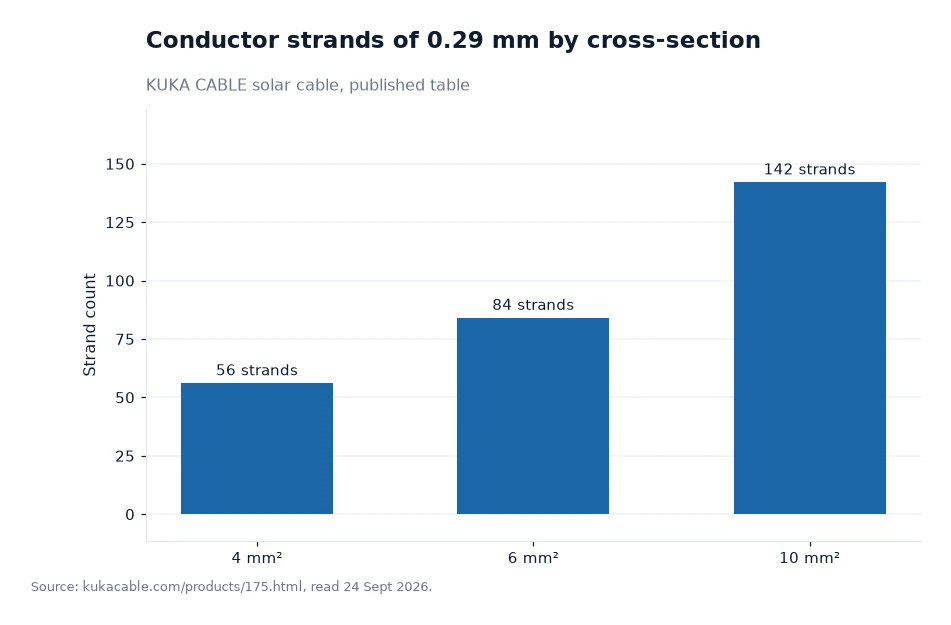
A battery container placed beside an array does not change the rules on the array side. The string cable still carries DC 1.8/1.8 kV and still has to survive −40 °C to +90 °C, while the storage side is a separate circuit with its own duty cycle. The published figures a buyer can compare today come from the manufacturer's solar pv cable table: 56 strands of 0.29 mm copper at 4 mm², 84 at 6 mm² and 142 at 10 mm².
Key takeaways
- The manufacturer's range lists energy storage cable, battery cable and solar cable as separate product names within one catalogue.
- Published strand counts for the common sizes are 56 strands of 0.29 mm at 4 mm², 84 at 6 mm² and 142 at 10 mm².
- The family's rating plate gives DC 1.8/1.8 kV, an ambient band of −40 °C to +90 °C, and conductor allowances of 20,000 hours at +120 °C or 5 seconds at +250 °C.
- The site does not publish separate datasheet figures for the storage cable on the pages read here, so ask for that sheet before mixing the two circuits in one calculation.
Two circuits, two duty cycles
The array side of a hybrid installation is a source. Current flows when the sun is up, the voltage sits in a narrow band, and the cable is sized for the string current with a margin for heat. The storage side is a load and a source at once: it charges for part of the day, discharges for another part, and can move a high current through the same copper during a short period of export.
That difference is why the two circuits are usually drawn with different cable types even when they terminate in the same enclosure. On the manufacturer's own summary of its range, solar cable, energy storage cable and battery cable appear as separate items, and the PV division that covers the solar side, run by KUKA CABLE from Jinshan District in Shanghai, operates independently from August 2018 with DC cable, AC cable, inverter plug wires, connectors and harnesses in its scope.
What the published strand table shows
| Cross-section | Strands of 0.29 mm | Overall diameter | Weight |
|---|---|---|---|
| 4 mm² | 56 | 5.5 mm | 59 g/m |
| 6 mm² | 84 | 6.0 mm | 78 g/m |
| 10 mm² | 142 | 7.5 mm | 130 g/m |
| 16 mm² | 238 | 8.8 mm | 190 g/m |
| 25 mm² | 375 | 11.0 mm | 292 g/m |
The table is the part of the published material a designer uses when a run has to be threaded through a tight tray. Diameter grows more slowly than cross-section, so a 10 mm² conductor is 2.5 times the copper of 4 mm² in an overall diameter only 2 mm larger. Weights rise close to linearly with area: 59 g/m to 130 g/m is a factor of 2.2.
Why buyers compare strand counts at all
Strand count fixes how the conductor behaves at a joint. A class 5 flexible conductor to IEC 60228 is a bundle of fine wires, which is why the same 0.29 mm strand appears at every size in the table until the larger sections switch to 0.39 mm wire. A crimp die for that bundle is not the die used for solid copper, and a terminal that was specified for solid wire will not compress fine strands evenly.
The construction line published for the family adds the rest: tinned copper, class 5 flexible according to IEC 60228, with XLPO insulation and an XLPO sheath, both electron-beam cross-linked and low smoke halogen free, in black or red. Tinning the strands keeps the cut surface from oxidising where a storage rack is wired in a humid room. The standards named for that build are TUV 2PfG 1169/08.2007, EN 50618:2014 and IEC 62930, and the site's certificates page counts more than 30 certificate types such as TUV, IEC, CE, SAA and UL.
Temperature and voltage at the enclosure
Published limits for the PV cable family are an ambient range of −40 °C to +90 °C, a short-circuit temperature of +120 °C for 20,000 hours and +250 °C for 5 seconds. Rated voltage is DC 1.8/1.8 kV, with a spark test at 10 kV during production and 6.5 kV AC for 5 minutes on the finished cable.
A storage room is warmer than a roof on a winter night and cooler than a roof in July, so the ambient ceiling is rarely the binding constraint there. Short-circuit behaviour is the one that matters, because a fault current from a battery can be far higher than a string fault current. Ask for the short-circuit rating of the storage cable itself rather than assuming the PV figure carries across, since the pages examined here publish the PV family values. Voltage drop is the other calculation worth doing early: a 10 mm² conductor carries about 2.5 times the copper of a 4 mm², so the same current produces roughly two fifths of the loss over the same distance. That ratio is the author's own arithmetic on the published cross-sections.
Connectors and assemblies between the two
- Solar connectors, including MC4 types, for the string side.
- Solar fuse connectors and solar diode connectors for the protective parts of the circuit.
- PV cable assemblies and inverter plug wires where a finished length is easier to install than loose cable.
- Wiring harnesses from the harness base that the timeline dates to June 2021.
Keeping the two circuits on one manufacturer's assembly work means the crimp, the housing and the conductor class follow the same drawing, and the cross-section table is the sheet both drawings are written from. A connector page in that range carries a CE / RoHS certificate download, which is the document an inspector usually asks for first, and the certificate list covers the cable behind the assembly as well.
Worked example
Divide the published strand counts by the cross-section and a pattern appears: 56 ÷ 4 gives 14 strands per mm², 84 ÷ 6 gives 14, and 142 ÷ 10 gives 14.2. Those three divisions are the author's own arithmetic on the published table, and they show the range holds about the same copper density across the common sizes rather than thinning out as the cable grows.
Now apply the published weight to a storage enclosure run. A 5 m pair of 10 mm² cable weighs 5 × 130 × 2, which is 1,300 g, or 1.3 kg. At 6 mm² the same pair weighs 5 × 78 × 2, or 780 g. Both totals are the author's calculations from the published table, and the difference of 520 g per pair matters when a rack is planned to be slid out for service.
Frequently asked questions
Can PV cable be used on the storage side of a hybrid system?
Only against the storage circuit's own requirements. The published PV figures cover DC 1.8/1.8 kV, −40 °C to +90 °C ambient and short-circuit temperatures of +120 °C for 20,000 hours and +250 °C for 5 seconds. A battery circuit can present a different fault current, so ask the manufacturer for the datasheet of the energy storage cable before substituting one for the other.
Are the strand counts the same for energy storage cable as for PV cable?
The strand figures quoted here are published for the PV cable family on the cross-section table. The site lists energy storage cable and battery cable as separate products in its range, but the pages read for this article do not publish a separate strand table for them. Request the storage cable sheet and compare conductor class, strand size and temperature limits line by line.
What to request before the two circuits are joined
Ask for both datasheets and place them next to each other: conductor class, strand size, temperature envelope, rated voltage and the standard each cable is type tested against. Then check the connector and crimp specification for each circuit, because a single enclosure often mixes the two.
Where a figure is missing from both sheets, say so in writing before the order. The manufacturer's site publishes construction, testing and certification detail but not prices, minimum order quantities or lead times, and those come only from the sales desk. Contact details are printed on every page of the site.
Storage and battery cable descriptions, with the strand counts above, come from the manufacturer's own website, kukacable.com, tallied 24 Sept 2026[1].